Nine hikers cut their way out of their own tent — from the inside — and walked into a night thirty degrees below zero.
What were they running from?
That is the question at the center of the Dyatlov Pass incident, and it has been standing there, unanswered, for more than sixty years. Not for lack of trying. Investigators have tried. Scientists have tried. Two governments have tried. The mountain has kept its version of the night, and everybody else has been left holding pieces of a story that refuses to assemble.
This is Told As Told, our series for the stories people swear are true. So here is the deal we make with you, the same one we make in every installment: first you get the record, in full, the way it stands. Then you get the best explanation science has built on top of it — with its honest weight, including the part where the scientists themselves tell you it isn't proof. What you decide is yours.
THE TEAM
February 1959. The Ural Mountains, in the Soviet Union.
The nine were not tourists, and they were not fools. They were experienced hikers from the Ural Polytechnic, out on a ski trek to earn the highest grade in their sport — the top certification, the kind you don't get handed for showing up. Trips like this one were how serious Soviet hikers proved themselves: deep winter, high country, self-supported, weeks of it. Whatever else is true about what happened to them, this much is plain in the record: they knew cold, they knew snow, and they knew what a bad night in the mountains demanded of you.
Their leader was Igor Dyatlov, and the pass where it happened would take his name. He was, by every account the record holds, exactly the man you'd want making the calls out there — methodical, experienced, trusted by the nine who followed him into the Urals in the last winter of the nineteen-fifties.
Hold on to that, because everything strange in this story is strange precisely because of who they were. Novices panic. Novices make the rookie mistakes that get written up as lessons. This team did none of the things novices do. What they did, on their last night, is something no one has ever fully explained — and they did it together, all nine of them, at once.
THE TENT ON DEAD MOUNTAIN
On February 1st, the team pitched their tent on the slope of Kholat Syakhl.
The name translates to Dead Mountain.
A name like that hangs over a story all by itself, and storytellers have been leaning on it for sixty years. But strip the poetry out and look at the practical fact: pitching on an open slope, rather than down in the shelter of the trees, was a decision. Experienced teams make camp where they make it for reasons — wind, snow conditions, the route waiting for them in the morning. They cut a platform into the slope, set the tent on it, and settled in for the night, with a hard day's travel behind them and the rest of the trek ahead.
Nothing in the record of that evening suggests trouble. The strangeness arrives later, sometime in the dark, and it arrives all at once.
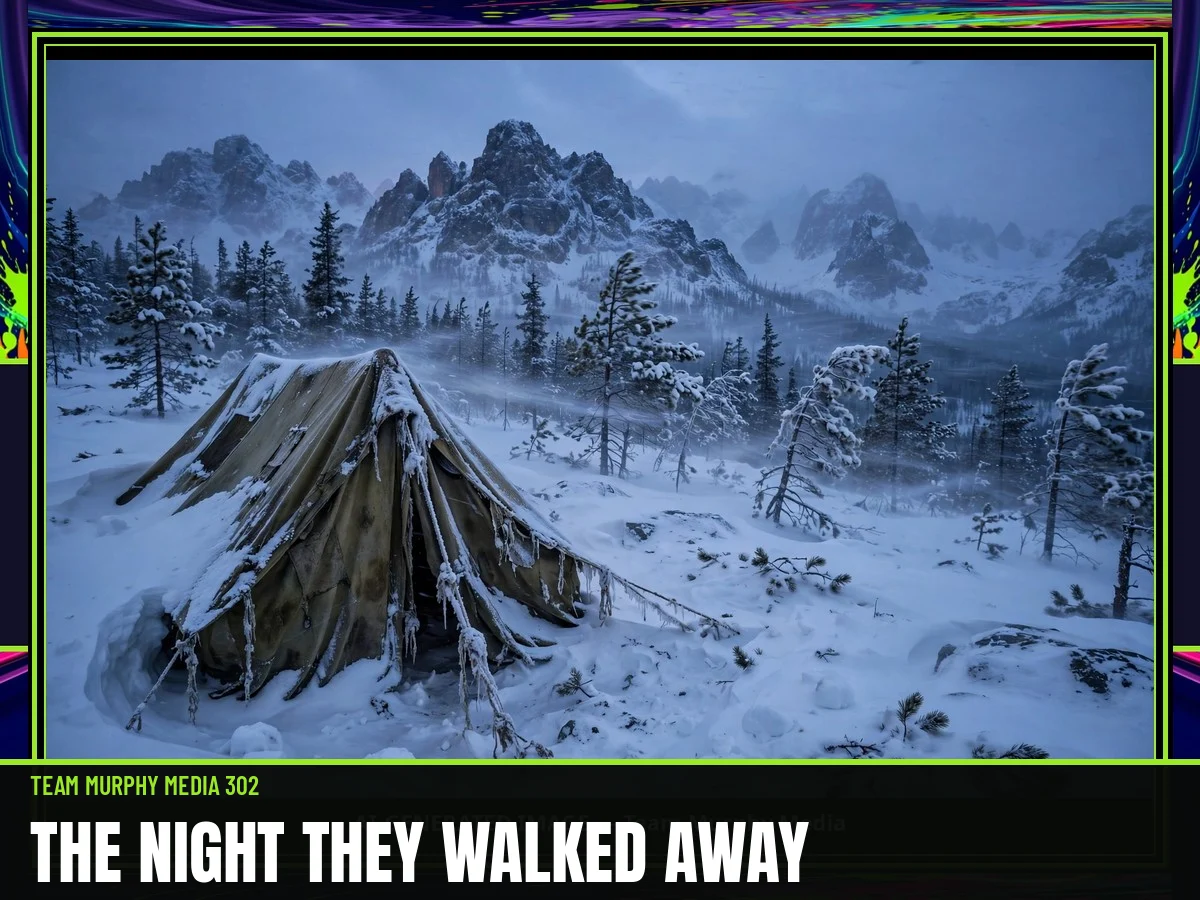
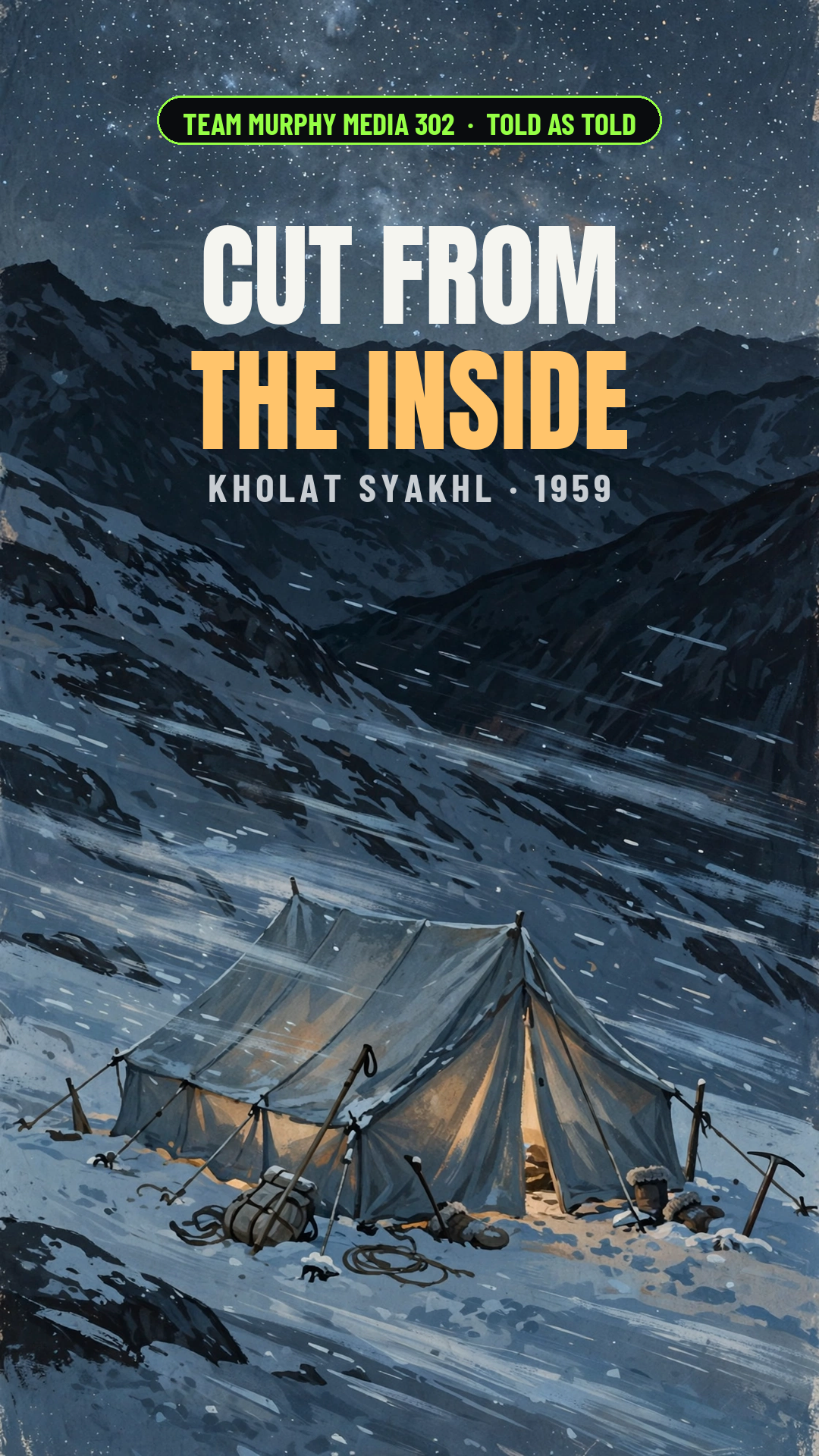
Because that night, something made nine people slash open their own tent — from the inside — and leave.
Not through the entrance. Through the wall. They cut their way out of the one structure standing between them and a night thirty degrees below zero, and they went out into it. Every theory of this case, every single one, has to start by explaining that cut — made by people who understood better than almost anyone alive what the cold outside that tent wall could do to them, and who chose it anyway.
THE WALK DOWNHILL
Here is the detail that has outlasted every explanation. It isn't the cut in the tent. It's what the snow recorded next.
Boots stayed in the tent. Coats stayed in the tent.
The footprints led downhill — in socks. Walking. Not running. Walking, into the dark and the cold.
Read that the way the searchers had to read it. Nine people fled their shelter so urgently that they cut through its wall rather than use the door — and then, having fled, they walked. In socks, in killing cold, down the slope, in an orderly line of footprints that the snow kept like a stenographer. If they were running from something, it did not chase them into a sprint. If they were panicked, the panic stopped at the tent wall and turned into something eerily calm.
That contradiction sits at the heart of the whole case, and it has never moved. Terror explains the cut. Nothing simple explains the walk.
What they were walking toward, or away from, no living person knows. The footprints are the last clear sentence the nine ever wrote, and they wrote it with their feet, going down.
THE SEARCH
When the team failed to come home, the search began — and the mountain gave its evidence back slowly, the way it still does.
Searchers found the tent first, caved in under the snow on the slope of Dead Mountain. Empty. Slashed from inside, with the team's boots and coats and gear still in it. A shelter abandoned by people who plainly intended, at some point, to come back to it — you do not leave your boots in a Siberian winter night unless you believe the leaving is temporary.
Then, one by one over the following weeks, they found the nine.
The first of them were found near a great cedar tree, down the slope from the tent. The last of them were not found until May — months later — in a ravine under the snow, where the melt had to finish what the search could not. February to May. That is how long the mountain held on to some of them, and how long the families waited while winter slowly handed back its dead.
SIX AND THREE
When the nine were finally all accounted for, the record settled into a shape that no single story has ever comfortably held.
Six had died of the cold.
Three others had injuries the doctors compared to a car crash — crushed, with no marks on the skin above them.
Sit with that the way the investigators had to sit with it. Six deaths the mountain explains all by itself; cold is a sufficient killer, and it needs no help. But three young, strong people bore the kind of internal force the doctors associated with a vehicle collision — force that left the surface unmarked. Nothing on that slope was supposed to be able to do that. There was no cliff in their story, no machinery, no traffic. There was a tent, a slope, a cedar tree, a ravine, and nine people in socks.
And one more detail, smaller, stranger, the kind that keeps a file from ever quite closing: on some of their clothing, examiners found traces of radiation.
The record states it and then moves on, because the record has nowhere to put it. Neither does anyone else. It sits in the case like a word in a language nobody reads — noted, unexplained, and impossible to forget once you've heard it.
A COMPELLING NATURAL FORCE
The Soviet investigation did what investigations are supposed to do. It gathered the tent, the footprints, the doctors' findings, the traces on the clothing. And then it closed the case with five words:
A compelling natural force.
Then the file was sealed.
Five words that explain nothing while somehow conceding everything. A compelling natural force — not an accident with a name, not weather with a date on it, just a force, compelling, natural, full stop. The state that ran that mountain range, that owned the file and the investigators and the very ground the tent stood on, looked at everything its own people found and wrote down a shrug in triplicate — and then locked the shrug in a drawer for decades.
If the case had been solved, the file would not have needed sealing. If it had been ordinary, the verdict would have had a noun in it. Instead there are those five words, and the long silence after them, and into that silence rushed everything a sealed file invites.
SIXTY YEARS OF GUESSES
For decades, the theories multiplied.
Military tests on a dark mountainside. Infrasound — sound below hearing, conjured by wind around the peaks, said to be capable of seeding a dread no one can reason with. Something in the dark that never got a name at all.
None of them closed it.
Each theory explained a piece and broke on the rest. The tests explained the radiation and broke on the footprints. The infrasound explained the dread and broke on the doctors' findings. Round and round it went, decade after decade, the story hardening into legend — the tent cut from inside becoming one of the most famous images in all of unsolved history, nine names attached to a question that outlived the country they died in.
The Soviet Union ended. The files aged. The nine stayed exactly where the mountain left them: young, experienced, and walking downhill in socks, forever, in the first pages of the story.
Then, sixty years on, the case did something cold cases almost never do. It moved.
THE ANSWER IN THE SNOW
In 2019, Russia reopened the case.
And in 2021, two scientists — Gaume and Puzrin — published a model built on snow physics.
Here is where the coldest case in the mountains takes the strangest turn in its long history, because the physics in that model came, in part, from code written to simulate snow for Disney's Frozen. The animated snow that slid off a cartoon mountainside for a generation of children turned out to behave, mathematically, like the real thing — and two researchers took that simulation machinery and pointed it at Dead Mountain.
Their answer: a slab.
A slab is a layer of wind-packed snow — dense, cohesive, laid down by the wind on top of weaker snow beneath it. The team, cutting their platform into the slope that February afternoon, had sliced into exactly that layering. And hours later — hours, in the dark, while they slept — the weakened slab above their tent let go. Not a mountainside avalanche of legend. A small, late slide, a slab of snow coming down like a slow door closing, on a slope everyone had called too gentle for one.
It accounted for the things nothing else could hold at once. A slab striking a tent in the night explains why people would cut their way out from inside — the entrance buried, the snow load pressing down, the whole shelter suddenly a trap instead of a refuge. It explains leaving in haste, in socks, with the boots still in the tent. And in the researchers' simulations, the forces involved matched even the strange injuries — the car-crash forces with the unmarked skin — because a human body stopped against something unyielding, under a mass of dense snow, takes exactly that kind of harm.
Expeditions since have photographed fresh slab avalanches on that very slope. The gentle slope. The one where it couldn't happen.
It is, by the standards of this case, a beautiful piece of work. Physics, patiently applied, sixty years late, answering the footprints and the cut and the doctors in a single motion.
WHAT'S LEFT
But the researchers themselves say it plainly: highly likely — not proven.
Those are their words, and they matter more than any theory shouted over them. Gaume and Puzrin built the best answer the case has ever had, and then refused to call it the answer. Because a model is not a witness. Snow physics can tell you what could have happened on that slope; it cannot tell you what nine people heard in the dark that made them cut the tent wall instead of digging for the door. It cannot spend the radiation traces. It cannot unseal what the sealed file saw fit to name only as a force.
No one alive knows what those nine young people heard, in the dark, on Dead Mountain.
That is where the record leaves us, and this series does not pretend otherwise. A slab of wind-packed snow, released hours after a platform was cut into a gentle slope, explains more of this night than sixty years of guessing managed to do — and the men who proved it possible still stop one word short of solved. Between the footprints going down, walking, and the five-word verdict in a sealed drawer, there remains a space that physics has narrowed and nobody has closed.
Snow and wind — or something the sealed file never named.
In memory of the nine.
You decide.
Watch the telling: our animated version of this story — COLD GROUND, Episode 1 of Told As Told — is live on TikTok and YouTube at Team Murphy Media 302. Sources: the story as told in our animated telling, built from the documented record of the Dyatlov Pass incident, 1959; the 2021 snow-physics model of Gaume and Puzrin. Art: cover illustration from the Told As Told animated telling of this story, created in-house for Team Murphy Media 302 (illustration, not a photograph).