THEY VOTED AT 2:53 IN THE MORNING. BY WEDNESDAY, YOU WON'T KNOW WHO GOT ARRESTED.
2:53 in the morning.
Let that sink in for a second. Not 2:53 in the afternoon, when the public galleries are open and the reporters are in their seats and people can watch their government work. 2:53 in the morning — the middle of the night, on July 1st, the final hours of Delaware's 2026 legislative session. Everyone exhausted. The building half-empty. Nobody watching.
That's when the Delaware House of Representatives took up House Bill 59. That's when they passed it. And Governor Matt Meyer signed it into law in late July, quietly, the way you sign something you don't want a lot of questions about.
This Wednesday — October 21st, two days from now — it takes effect.
And when it does, Delaware law enforcement will be barred from telling you the names of most people they arrest. No names. No photographs. No mugshots. For the vast majority of arrests in this state, the public will get nothing.
WHAT THE LAW ACTUALLY DOES
House Bill 59 amends Title 11, Section 1913 of the Delaware Code. That section used to do one thing: it prohibited police from releasing the names and photographs of juveniles — kids 17 and under — who'd been arrested or were suspected of crimes, unless the juvenile was charged with a violent felony.
What HB 59 does is take that juvenile protection and stretch it over every adult in the state. As of Wednesday, no law enforcement agency in Delaware may release or publish the name or photograph — and the law specifically defines "photograph" to include mugshots — of any individual arrested or suspected of committing a crime, unless the person is charged with a violent felony and officials determine the release serves public safety.
Sponsors: Representative Lynn and Senator Hoffner, with a slate of House cosponsors behind them. It passed in the dark and got a signature in the summer. And now here we are, 48 hours from it going live, and most Delawareans have no idea it's happening.
THE ARGUMENT FOR IT — AND WHY IT ISN'T CRAZY
To be fair, the people behind this bill aren't making it up out of nothing. Representative Lynn has said plainly what motivated him: when someone is charged with a misdemeanor — charged, not convicted — and their name and face get published, it subjects them to "public embarrassment and ridicule." And he's right that the internet never forgets. A mugshot from a charge that got dismissed, a case that fell apart, an arrest that led nowhere — it follows people for years. Employers Google names. Landlords Google names. Dates Google names.
And the harm doesn't fall evenly. Study after study has shown that minorities are disproportionately represented in mugshot galleries and crime coverage. Newsrooms across the country have wrestled with this — including Delaware Online and The News Journal, which rarely covers isolated nonviolent crimes, typically doesn't name people charged with low-level offenses without a compelling public safety reason, and rarely publishes mugshots at all.
So the concern is real. Nobody wants to ruin someone's life over a misdemeanor charge that went nowhere. That's a legitimate debate, and it deserves to be had in the open.
But there's a simpler way to say the other side of it: maybe don't commit the crime if you don't want your mugshot up. Nobody forced anyone into the back of a squad car. Actions have consequences — and one of the consequences of getting arrested used to be that your neighbors found out about it. You don't get to do the crime and then demand privacy about it.
Which is exactly why they had it at 2:53 in the morning.
THE ARGUMENT AGAINST IT — AND WHY THE COPS ARE FURIOUS
Here's the problem: the bill doesn't just shield misdemeanor defendants from embarrassment. It's written so broadly, and the "public safety" exception is defined so vaguely, that police chiefs across the state are saying they won't know what they're allowed to tell the public anymore.
New Castle County Police Chief James Leonard — the man who runs one of the largest departments in the state — didn't hedge: "The effect is, the name of a person who commits a quadruple homicide but was apprehended within the hour of the incident will not be made public. The fact that they will not be known to the public... is flabbergasting to me."
Read that quote again. A quadruple homicide. Suspect caught within the hour. And the chief of police is telling you that under this law, he might not be allowed to tell you the suspect's name.
How is that possible? Because the law's release valve — the part that lets police name someone — only opens for violent felonies where officials decide disclosure protects public safety. But the law never defines what meets that standard. Is a captured suspect a continued threat? If he's in custody, arguably not. So does the exception even apply? Nobody knows. The police don't know. The lawyers don't know. You'll find out Wednesday, when they start guessing.
Wilmington attorney Thomas Neuberger, who's spent a career in Delaware courtrooms, put it bluntly: the public has "lost access to a lot of information." And remember — Delaware was already one of the hardest states in the nation to get public records out of. This isn't a state that was drowning in transparency and needed to dial it back. This is a state that was already one of the most secretive in the nation, deciding to get more secretive, at 2:53 in the morning.
THE PART NOBODY'S TALKING ABOUT
Let's talk about who benefits most from a law that lets officials decide whose names the public gets to know.
In theory — and this isn't speculation, it's the plain reading of the statute — a public official arrested on corruption charges could now be shielded from public scrutiny. Corruption isn't a violent felony. A councilman caught taking bribes, a state employee caught stealing, an elected official caught dead to rights — if their arrest isn't deemed a "threat to public safety," there's no mechanism to release their name. The press can't report what the police won't confirm.
The people who write the laws just voted themselves the power to disappear from the crime blotter. At 2:53 in the morning. While you were asleep.
Ask yourself: if this bill was really just about protecting misdemeanor defendants from embarrassment, why not carve out public officials? Why not carve out DUI? Why not write a clear standard instead of leaving it to "discretion"? Why pass it when no one was watching?
WHAT WEDNESDAY LOOKS LIKE
So here's the practical reality, starting in two days.
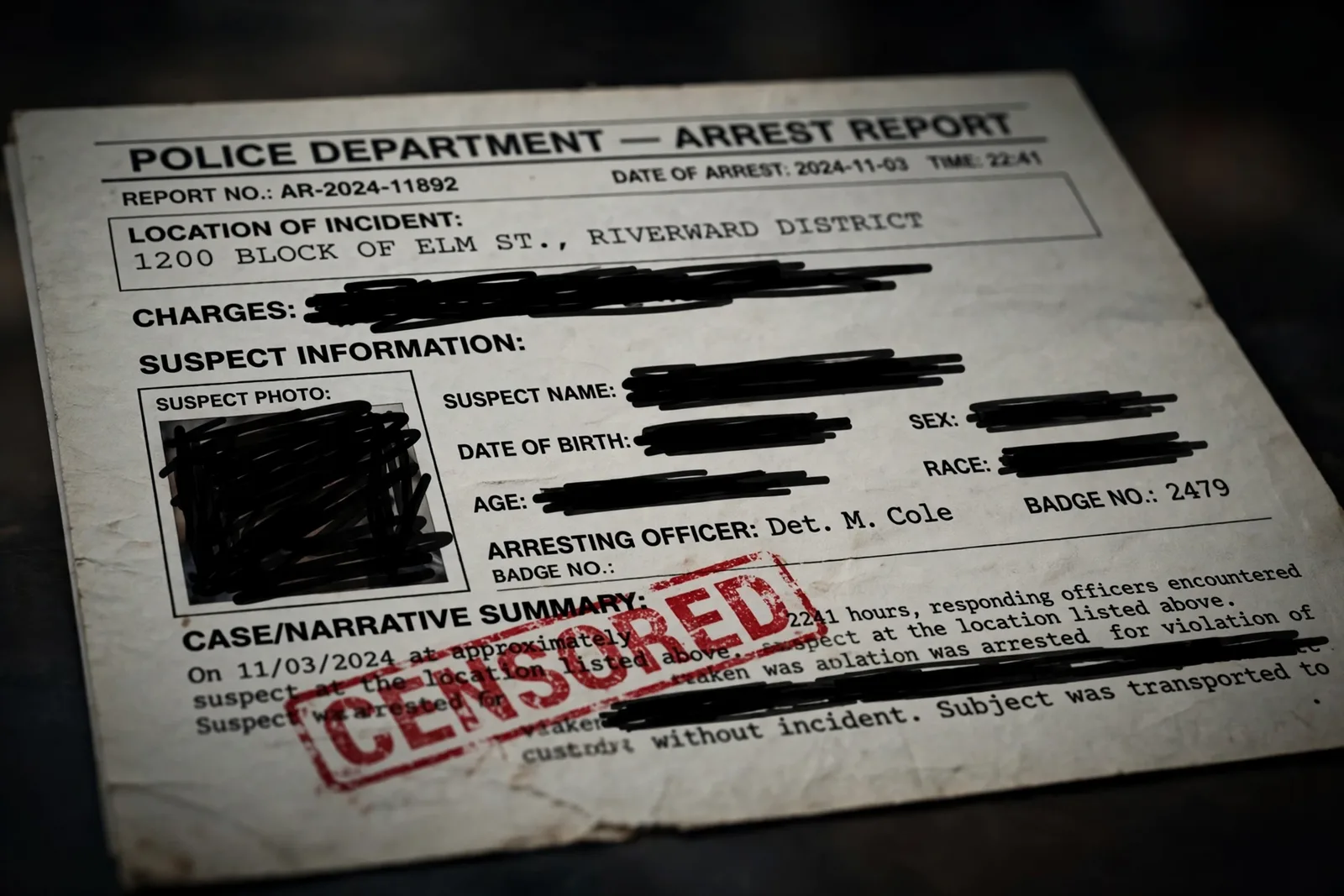
Someone gets arrested in your neighborhood — a burglary on your street, a DUI at the intersection by your kid's school, an assault at the bar down the road. The police report that used to say "John Smith, 34, of Wilmington, was arrested and charged with..." will now say "a 34-year-old male was arrested." That's it. That's all you get.
If he's your neighbor, you won't know. If he was arrested last month for the same thing, you won't know that either. If the victim wants to know who did it to them, they may not be told — at least not by the police, at least not on the record.
And for people like us — independent outlets trying to keep the public informed — it means the raw material of accountability journalism just got a lot harder to get. When the police won't name names, the public has to trust the police's judgment about what the public needs to know. That's a lot of trust to place in an institution, especially when the law was designed to reduce what you get to see.
THE VOTE THEY DIDN'T WANT YOU TO SEE
Let's go back to 2:53 AM, because the process here matters as much as the substance.
Delaware's legislative session ends June 30th. The final night is always a marathon — bills stacked up, deals cut in hallways, votes called at hours when no working person is awake to watch. It's the least transparent night of the year in Dover, every year, by design. Leadership schedules the controversial stuff for the hours when the galleries are empty.
HB 59 went through at 2:53 AM on July 1st — technically the morning after the session's last day, in the bleary stretch when lawmakers are running on fumes and the only people left in the building are the ones paid to be there.
If the sponsors believed this bill could survive daylight — real debate, public scrutiny, reporters asking questions, constituents calling offices — they'd have run it at noon. They didn't. They ran it at an hour when the only witnesses were the ones who'd already agreed to vote for it.
That's not how you pass a law you're proud of. That's how you pass a law you hope nobody notices until it's too late.
Well. We noticed.
WHAT HAPPENS NOW
The law takes effect Wednesday, October 21st. There's no indication of a repeal effort, no court challenge filed yet, no emergency brake. Barring something unexpected, Delaware is about to become a state where the government decides what you get to know about crime in your own community — and the default answer is "less."
If that bothers you, the people to call are the ones who voted for it at 2:53 in the morning. They're listed on the bill. Representative Lynn. Senator Hoffner. Every cosponsor. Their offices have phones. The session may be over, but the next election isn't.
Wednesday's coming. Remember who turned out the lights.
If you'd like us to continue this work and keep Shop Talk Weekly subscriptions free, consider making a donation: Cash App $dj7309 · PayPal paypal.me/dj7309. Can't donate? Like, share & subscribe — that costs nothing and means everything.
Brought to you by Team Murphy Media.