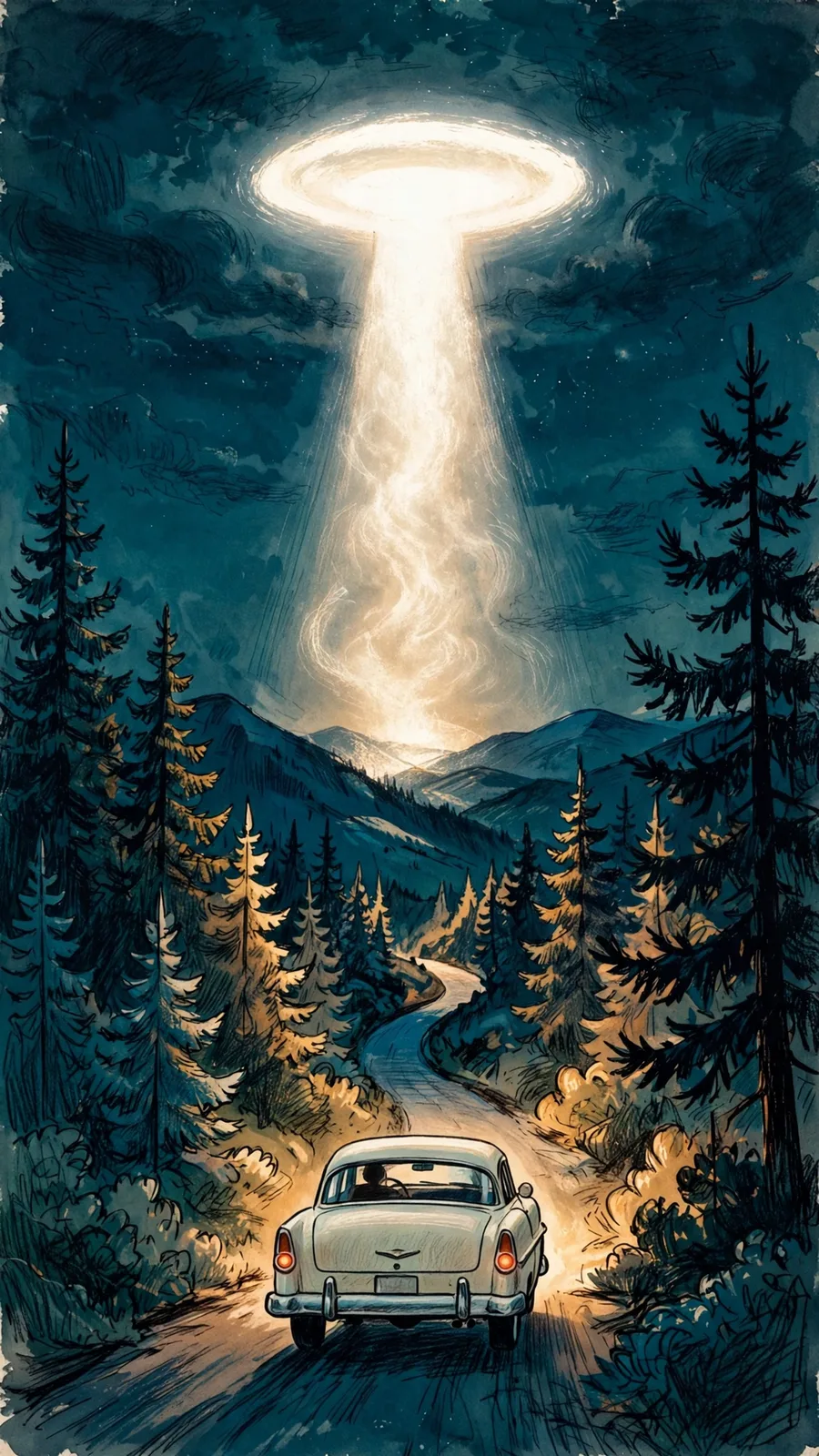
The drive down from the Canadian border to Portsmouth, New Hampshire, takes about four hours. On the night of September 19, 1961, it took Betty and Barney Hill seven.
Neither of them could ever account for the difference. Not that night, not three years later in a psychiatrist’s office, and not in all the years of telling that followed. Two hours of their lives were simply gone — and what filled the gap, once it finally surfaced, became the first alien abduction story in American history, and the template every one since has followed.
This is Told As Told, our series for the stories people swear are true. So here is the deal we make with you, the same one we make in every installment: first you get their account, in full, told the way they told it. Then you get the other side of the record, with its honest weight. What you decide is yours.
THE COUPLE
Betty and Barney Hill were not the kind of people who went looking for this. Barney, 39, worked nights for the post office. Betty, 41, was a social worker for the state. They were churchgoing, civic-minded, active in the civil rights movement — Barney served on a state civil rights commission — and they were an interracial couple in 1961 New Hampshire, which meant they already had enough experience of being stared at and disbelieved to last a lifetime. Friends described them the same way for forty years: steady, respectable, and not given to invention.
In September 1961 they took a short vacation — Niagara Falls and Montreal — and on the 19th they turned for home, driving south through the White Mountains on Route 3 with their dog, Delsey, asleep in the back seat. It was a clear night, and the road was nearly empty.
THE LIGHT
Betty saw it first: a bright light in the sky that behaved wrong. It looked like a falling star, she said later — until it climbed. It moved against the field of fixed stars, changed direction, and seemed to keep pace with the car. Barney, the skeptic of the two, told her it was a plane, then a helicopter, then stopped offering explanations.
They stopped the car more than once to watch it. Then Barney got out with the binoculars.
What he described seeing, he described for the rest of his life, and it never changed: the object swung low and close — huge, silent, tilted. Along its side ran a row of windows. Behind the windows were figures. Watching him.
“They’re going to capture us,” he shouted, and ran for the car.
THE BEEPS
What happened next is the strangest part of the story precisely because, for a long time, neither of them could remember it at all.
Barney floored the Chevy down Route 3. Then the car was filled with a sound: a rhythmic beeping, coming off the trunk, as if something were bouncing a signal off the metal. The car tingled — Betty used the word “vibrating” — the way a tuning fork feels in your hand. A second set of beeps came. And then, by their account, nothing. No memory at all.
They arrived home in Portsmouth at dawn. The drive that should have taken four hours had taken seven. Roughly thirty-five miles of road — and about two hours — were unaccounted for.
THE DAYS AFTER
The Hills did not run to the newspapers. They told family. They told their church. They reported the sighting to the Air Force at Pease Air Force Base, and the report went into the Project Blue Book files as an unexplained sighting they could never quite close the drawer on.
And there were small, physical things, the kind of details that have kept this story alive for sixty years. Their watches had stopped. Barney’s shoes were scuffed on top, as if he had been dragged or carried. The strap on the binoculars was broken clean. Betty’s dress was torn. On the trunk of the car they found a pattern of shiny spots — and, they said, a compass needle brought near those spots spun wildly instead of settling. None of it proved anything. All of it bothered them, because none of it had been there the day before.
Betty, a reader, wrote to a civilian UFO research group describing the sighting. She also, fatefully, went to the library.
THE DREAMS
Within days of the drive, Betty began to dream — vividly, the same dream, five nights running, the kind of dreams that arrive like memories wearing a disguise.
In the dreams, the car was stopped at a roadblock on the dark road. Men came out of the trees. She and Barney were walked into a disc-shaped craft, into a room like a doctor’s office. There was an examination: clinical, thorough, frightening. A needle-like instrument, and a test she understood to be something like a pregnancy test. And there was a map. One of the beings showed her a map of scattered dots — stars — and asked her if she knew where Earth was on it. She said she didn’t know, and laughed at her own ignorance, and he seemed amused, and put the map away.
She wrote the dreams down in detail. Barney didn’t dream. Barney just had two hours he couldn’t find, and a growing dread of the gap.
THE PSYCHIATRIST’S OFFICE
In 1964, on the advice of doctors who had treated Barney for anxiety and an ulcer, the Hills sat down with Dr. Benjamin Simon, a respected Boston psychiatrist who had treated shell-shocked soldiers with hypnosis during the war. Simon was no believer. He thought hypnosis might ease Barney’s anxiety by recovering whatever ordinary thing had frightened them on that road.
Over months of sessions, working with each of them separately, Simon regressed the Hills to the night of September 19, 1961 — and out of both of them, in separate rooms, came the same story.
Small men with large eyes. A disc on the ground in a clearing. Being taken aboard, examined on tables, samples taken. Barney, terrified, keeping his eyes shut for much of it. Betty, talkative even in trance, asking questions — and being shown the map. Under hypnosis, at Simon’s direction, Betty drew it from memory: a scatter of dots connected by lines, some solid, some dashed, like trade routes and expeditions on a chart of somewhere no human had ever been.
Here is the part that the legend usually leaves out, and the record won’t let us: Dr. Simon himself did not believe the abduction happened. His professional conclusion, stated plainly, was that the Hills were utterly sincere — and that the abduction story was most likely a fantasy that had grown, in two honest minds, out of Betty’s dreams. The man who pulled the story out of them thought the dreams had written it. Hold on to that. It matters for what comes next.
THE MAP
Betty’s sketch sat in a drawer for years. Then it found Marjorie Fish.
Fish was an Ohio schoolteacher and amateur astronomer, and she did what no one else had thought to do: she tried to build the map in three dimensions. Working from the newest star catalogues, she strung beads and thread in a frame, hunting for a viewpoint — a place in space — from which real stars would fall into the pattern Betty had drawn. She worked at it for years.
She found the viewpoint. In Fish’s model, Betty’s dots matched a real neighborhood of stars, and at the heart of the pattern sat a binary system called Zeta Reticuli, about 39 light-years from Earth. Stranger still — on Fish’s reading, the map appeared to include stars that had not yet been catalogued when Betty drew it in 1964; the catalogue data confirming them came later.
In 1974, the fight went public in the pages of Astronomy magazine, and it has never really stopped. If the match is real, it is one of the most extraordinary documents of the twentieth century: a star chart, drawn from a dream, of a place humanity had not yet mapped. If it isn’t — well, the other side has something to say about that.
THE OTHER SIDE OF THE RECORD
Carl Sagan looked at Betty’s map and delivered the skeptic’s verdict in one sentence: he called it a random bunch of dots.
That is not a dismissal to wave away; it is the central problem. Given enough stars to choose from and enough freedom in choosing them, a determined modeler can find almost any pattern in the sky. Critics of Fish’s work argue that is exactly what happened — that the match was assembled by selection, bead by bead, until the beads agreed. Defenders answer that the match held stars nobody knew were there. Both of those things live in the record, and we are not going to pretend one of them doesn’t.
The hypnosis cuts the same way, and deeper. Memory researchers will tell you — and told anyone who would listen in 1964, too — that hypnosis does not work like a tape recorder. It builds memories as easily as it finds them, especially in a mind that arrives with a story already half-written by dreams. Betty had the dreams first; the hypnosis came after. That sequence is a fact, and skeptics are entitled to lean on it with their full weight. They lean on smaller things, too: that the night’s first light has been proposed as the planet Jupiter, then bright in that sky; that Betty was an interested reader on the subject within days of the event.
And yet. The record also holds this: two people with no money in it — they had to be dragged into public view in 1965, when a Boston newspaper got hold of their confidential medical story and printed it without their permission — told one story, separately, under hypnosis, and then stood behind it in public for the rest of their lives at real cost to their privacy and dignity. John G. Fuller’s book-length account, The Interrupted Journey, followed in 1966. Barney died in 1969, only 46, still telling it. Betty told it for thirty-five more years, until her death in 2004, and she never once sold a new version of it. She just told the same one.
WHAT’S LEFT
The state of New Hampshire has since done something no state had ever done: in 2011 it set Historical Marker No. 224 beside that stretch of highway — the first state highway marker in America for a UFO event. The Hills’ papers, and the tapes of the hypnosis sessions themselves, sit in the archives of the University of New Hampshire, where anyone can go and listen to two steady people describe, in frightened voices, the two hours they lost.
Because here is the thing about Route 3 in 1961: whatever did or didn’t happen in the White Mountains that night, everything that came after is downstream of it. The small grey figures with the large eyes. The examination table. The missing time. The map. Before the Hills, there were lights in the sky. After the Hills, there was a story — with people in it, and a shape that a thousand later accounts, sincere and otherwise, would pour themselves into. The age of abduction stories begins on that road, one way or the other.
Two hours, missing. A map, drawn from a dream. Something happened on that road in 1961 — or the age of abduction stories began there.
You decide.
Watch the telling: our animated version of this story — the first episode of Told As Told — is live now on TikTok and YouTube Shorts at Team Murphy Media 302. The Hills, the car, the beeping on the trunk, and Betty’s map, drawn in light.
Art: cover illustration from the Told As Told animated telling of this story, created in-house for Team Murphy Media 302 (illustration, not a photograph). Sources: the Hills’ account as published in John G. Fuller’s The Interrupted Journey (1966); the Dr. Benjamin Simon hypnosis record; Marjorie Fish’s star-map model and the 1974 Astronomy magazine exchange; New Hampshire Division of Historical Resources, Historical Marker No. 224; the Betty and Barney Hill papers, University of New Hampshire.
Donations keep this work free: Cash App $dj7309 · PayPal paypal.me/dj7309