
Team Murphy Media 302 · Investigative · Part 1 of a series

The raise
The CEO in that headline is Calvin Butler Jr. He runs Exelon — the corporation that owns Delmarva Power outright, through Pepco Holdings. The man you might see representing Delmarva locally is Tyler Anthony, president and CEO of Pepco Holdings; his personal pay is not publicly broken out, and no pay figure in this story belongs to him. The figures below belong to Butler, and they come from Exelon's own SEC proxy filings — the compensation paperwork the company files with the federal government, in the open, every year.
| Calvin Butler Jr., Exelon CEO — total compensation | Amount |
|---|---|
| 2024 | $14,662,925 |
| 2025 | $15,601,905 |
| One-year raise | +$938,980 |
What the 2025 package was made of, per the same filings:
| Component (2025) | Amount |
|---|---|
| Salary | $1,379,000 |
| Stock awards | $10,900,024 |
| Non-equity incentive pay | $2,665,719 |
| Change in pension value | $400,595 |
| All other compensation | $256,567 |
Now the headline's math, shown in full so anybody can check it: $15,601,905 − $14,662,925 = $938,980. A million dollars minus $938,980 is $61,020 — the headline rounds that to $61,000, and we're telling you it rounds it. Butler's pay works out to 103 times what Exelon's median employee makes, by Exelon's own disclosure. And 2025 wasn't even his biggest year: his raise from 2023 to 2024 was $2,396,205. Across two years, the top job's pay climbed $3,335,185 — about $3.3 million.
Keep that number in your pocket. Now open your power bill.
The bill you can't shop around
Delmarva Power is a state-sanctioned monopoly for about 344,000 Delaware electric customers. If you live in its territory, there is no other store. You pay their price, and their price is set in a hearing room in Dover most Delawareans have never heard of.
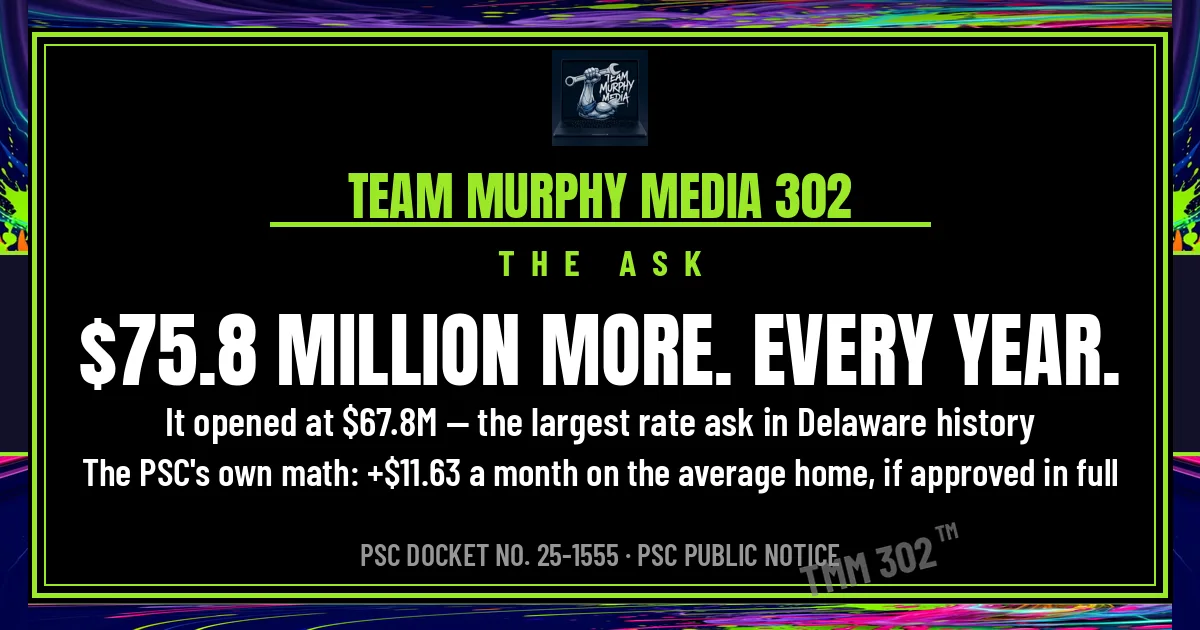
On December 9, 2025, Delmarva filed for the largest rate increase in Delaware history — PSC Docket No. 25-1555. The ask has grown twice since it landed:
| Docket 25-1555 — the ask | Amount | Note |
|---|---|---|
| Filed Dec. 9, 2025 | $67,783,312 | +21.7% over base rates — already the largest request in state history |
| Updated June 1, 2026 | $68,630,725 | |
| Final update, Aug. 31, 2026 | $75,829,980 | +24.25% |
Of the original ask, about $44.6 million is new revenue and about $23.2 million is money customers already pay through the DSIC surcharge, rolled into base rates. The flat monthly customer charge would rise from $13.50 to $15.94. This is Delmarva's third electric base-rate case in about five years — the 2020, 2022, and 2025 filings together sought roughly $160 million. And here's a piece of it you are already paying: under PSC Order No. 11037, Delmarva put 50% of the increase it was then requesting — $34.3 million a year — into bills starting July 9, 2026, subject to refund with interest if the final award comes in lower. A step-up to 75% ($51.45 million) is scheduled for December 9, 2026.
What does the full ask mean at your kitchen table? There are two honest numbers, and you deserve both, labeled:
| Figure | Impact | Basis |
|---|---|---|
| PSC (public notice, Docket 25-1555) | ≈ +$11.63/month (≈ $139.56/year) | Home using 834 kWh/month, distribution charges, final ask |
| Delmarva (company figure, Jan. 2026) | +$6.42/month (4.13%) | Home using 810 kWh, total bill, original $67.8M ask |
They don't contradict each other — one is the final ask measured on distribution charges only, the other is the smaller original ask measured against the whole bill. We print both because credibility is the whole franchise. By customer class, the PSC's table for the final ask has residential customers at +22.42%, residential space heating at +26.61%, and small general service at +23.46%.
The room where the profit is set
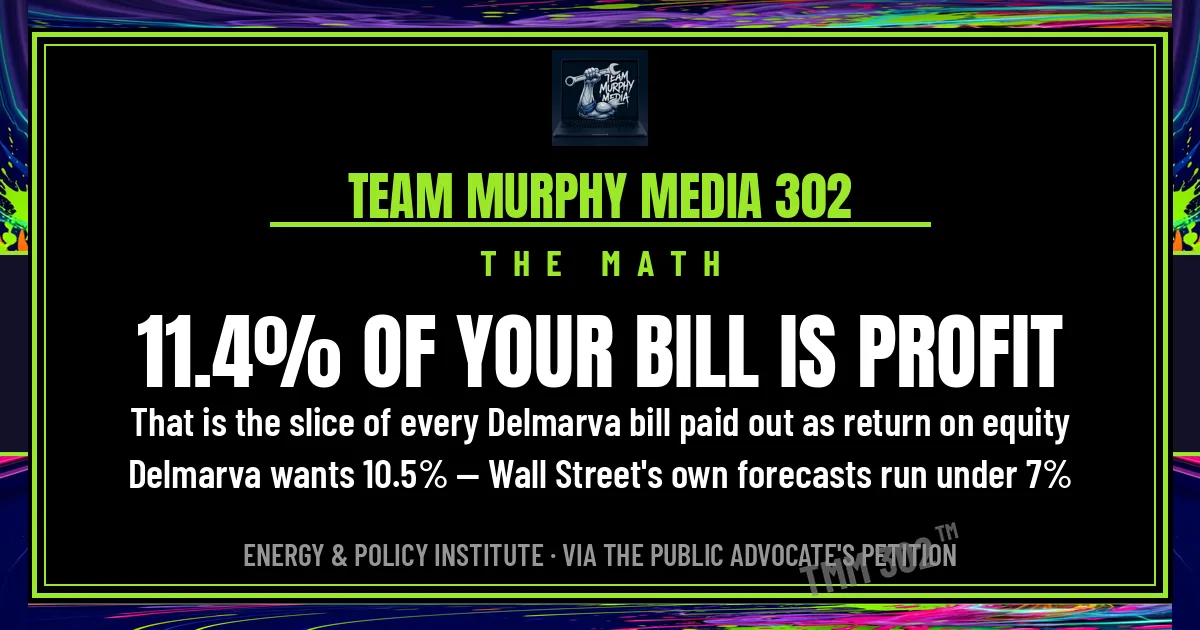
Buried in every Delmarva bill is a number nobody voted on: the return on equity, the state-authorized profit the PSC allows the company to earn on its shareholders' investment. Delmarva's last approved return was 9.6% (Docket No. 22-0897, settled April 2024). In the current case, Delmarva is asking for 10.5%. The national average authorized utility return is 9.75% — while market-based estimates of the return investors actually require to attract capital run about 6 to 7%, and no major Wall Street forecast projects long-term equity returns even reaching 9%.
On October 21, 2026, Delaware's Division of the Public Advocate — Jameson Tweedie's office, the officials paid to fight for customers — petitioned the PSC to open an expedited investigation into exactly that gap: whether state-set returns have become, in the petition's words, "a windfall to shareholders at the expense of ratepayers." Its filings say authorized returns nationwide likely run 50% or more above what investors actually require, that Exelon trades at roughly 60% above book value — the market's own signal that the returns on offer beat the risk — and that 11.4% of every Delmarva electric bill is profit. The petition also lays out why an oversized return costs you three times over: you pay the profit itself, you pay the income taxes on that profit through your rates, and the fat margin rewards the company for building more — whether the building is needed or not. Governor Matt Meyer publicly supports the petition; he called for it in June. One national estimate in the petition puts excess utility profit at roughly $300 extra per household per year — that figure is national, not Delaware-specific, and we label it that way.
The human ledger
- Almost 31,000 Delaware residential customers were disconnected in 2024 for nonpayment, per the U.S. Energy Information Administration's 2024 report, cited in the petition.
- Delaware residential distribution rates rose 105% from 2006 to 2025, per the Public Advocate's own historical review.
- Delmarva's annual capital spending went from under $70 million a year on average in 2018–19 to $176.2 million in 2025. Plant in service grew 31% in three years while its customer base grew 2.8%.
- Delmarva customers pay significantly more than Delaware Electric Cooperative customers at similar usage, per the petition.
- About 1 in 4 U.S. households couldn't pay a utility bill in full at least once in the past year — a national figure, cited in the petition, that matches what any Delawarean can see on their own street.
Delmarva's side, stated fairly
Delmarva Power gets its case in this piece, in its own numbers, because that's the deal on this page. The company's spokesman, Matthew Ford, says Delmarva "welcomes a review" of returns, and argues a return on equity is essential to attract the investment that keeps a grid standing. The company's own filing says its earned return at current rates is 4.08% — 6.28% counting DSIC surcharge revenue — well below the 9.6% it is authorized to earn. Those are Delmarva's figures from its application, attributed to Delmarva, and they're the heart of its argument: judge what we earn, not what we're allowed to ask for. The application also proposes a 20% low-income distribution discount and new bad-debt and bill-stabilization riders, and every interim dollar collected above the final award is exposed to refund with interest. Those arguments deserve a hearing. So does the Public Advocate's question — if the cap is set far above what capital actually costs, why is the customer the one making up the difference?
The law changed while this case was being filed
In 2026, Delaware passed Senate Bill 326 (signed by the Governor July 13), strengthening PSC oversight, and a new prudence standard for utility spending took effect at the start of the year. Delmarva filed this case on December 9, 2025 — days before the new standard took hold. Legislators, in a February 5, 2026 letter to the PSC, and advocacy groups accuse the company of timing the filing to stay under the older, friendlier business-judgment rule. That is their accusation, attributed to them — it is not this page's finding. What is on the record: in March 2026 the hearing officer applied the prudence standard by stipulation, and Delmarva consented to it on March 9. Delaware isn't the only state asking these questions, either — Pennsylvania's House unanimously passed a return-reform bill on June 22, 2026, built on a safe-harbor return of the 10-year Treasury rate plus 2% (about 7.3%) or a competitive auction for equity, a mechanism the Delaware petition also floats.
What happens next

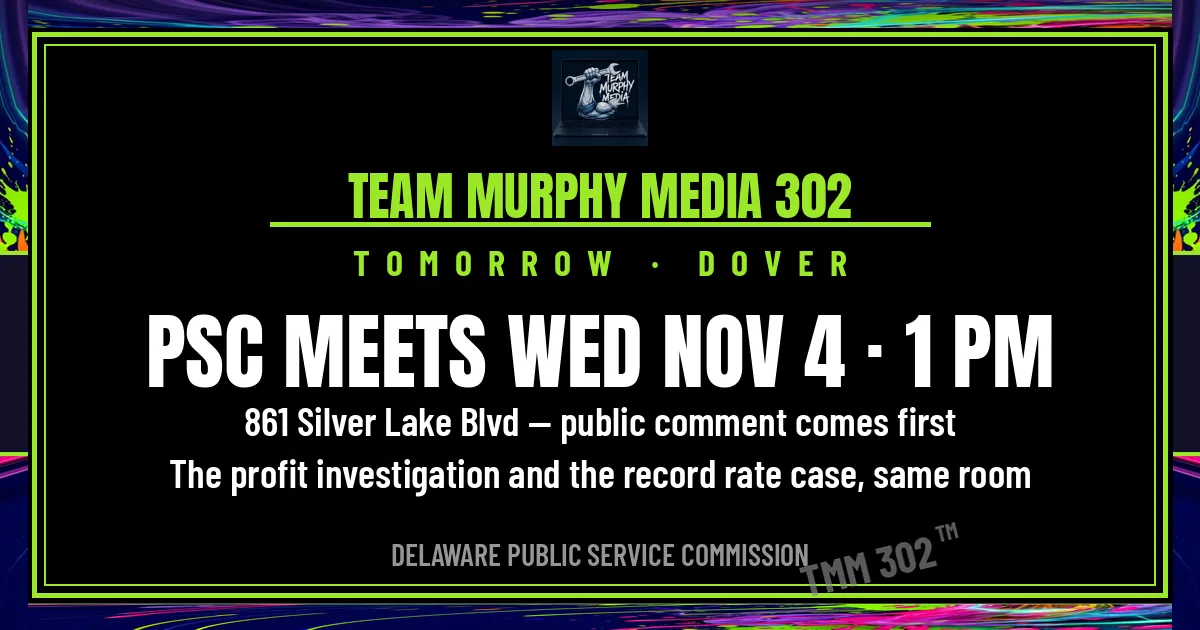
Tomorrow — Wednesday, November 4, at 1 PM — the Public Service Commission meets at the Cannon Building, 861 Silver Lake Blvd, Dover. Public comment opens the meeting, and right after it Delmarva Power itself takes the floor for a "State of the Company" presentation. Later in the meeting, the Commission takes up the Public Advocate's petition — PSC Docket No. 26-1045 — and decides whether to open the return-on-equity investigation, on the expedited clock the Public Advocate asked for: findings and reforms in time for the 2027 legislative session. The rate case itself (Docket No. 25-1555) is not an item at this meeting.
Written comments on Docket No. 25-1555 close the same day — Wednesday, November 4. Three ways in: file through DelaFile, email [email protected] with "Docket No. 25-1555" in the subject line, or mail the PSC at 861 Silver Lake Blvd, Suite 100, Dover. If your voice isn't in the record, it doesn't count.
My name is David Murphy. I'm a diesel mechanic from Smyrna, and this page is Team Murphy Media. David versus Goliath is not a metaphor here — it's the byline, and we're going to stay on this story for every docket step it takes.
Send us your power bill

We're building the Delaware Bill Board — a running tally of real Delaware power bills, checked against the PSC's own rate math: median monthly bill, the highest, county by county, updated as this case moves. Send us four things: your monthly total, the kWh you used, your town, and — if you can — a photo or screenshot of the bill with your account number and the barcode blacked out. Reach us in the Facebook comments or messages, or through the website. The privacy law here is iron: we never publish an account number, a full name, or an exact address without explicit permission — first name and town is the default — and DJ reads and reviews every reader story before any of it runs. Don't want to send it to a news page? Send it to the record instead — the PSC comment routes above are the official door, and both doors stay open in every installment of this series.
Part 2 of this series — what happens in the room on November 4 — publishes after the meeting.
Got a NEWS TIP? Send it our way — stories, road closures, things we should cover, that's what we're here for. But a tip about a crime, an emergency, or a missing person goes to the POLICE first, always. We're the megaphone, not the police tip line.